A blog about roleplaying games, from a roleplayer's perspective. Includes peeks sometimes into other geeky things.
About Me
Banner Ad
Showing posts with label epic. Show all posts
Friday, July 20, 2012
Rise: Capping Off a Story
Dear Readers: This is NOT a review of The Dark Knight Rises, because I haven't seen it yet, though I do plan on seeing it at 10 PM tonight. I just like the picture and theming, and considering that it's opening day for the final Bat-Nolan trilogy, it seems quite fitting. So, then, let me present to you: my thoughts on wrapping up a story with a bang.
Labels:
action,
creativity,
epic,
roleplaying,
storytelling,
suspense
Saturday, May 5, 2012
Assembling Action
We interrupt this normal broadcast of The Player's Side of the Screen to bring you a review of awesomeness...and perhaps an observation to help your gaming. I just saw The Avengers last night, one of the most-anticipated movies of the summer. And it was smashingly fantastic. I'm gonna embark on a spoiler-free review, along with some thoughts on action in gaming.
Thursday, January 21, 2010
An Examination of Epic, Part II
Part I
So, now I really ought to be getting back to that quite-promised post about the topic known as "epic"...well, at least, the second part of the post. The funny thing is, after such a long time delay, a lot of new topics have come to mind about epicness and the like. So, this is basically going to be the "tying up lost ends" post, with perhaps an example at the very end. With that said, let's go!
A Time for Heroics...
Last time around, I promised I'd address the question of timing. Well, here it is. Timing, in terms of the "epic" factor, is an incredibly important criterion to keep in line. If you go epic all the time, well...you risk not being nearly as epic as you want to. If you don't go epic at the right times, you lose a good bit of oomph. By the way, "oomph" is a highly technical term used frequently in the fields of mythological study.
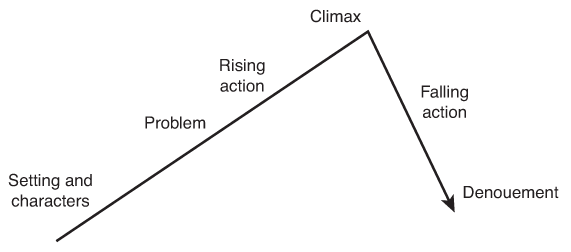
First off, I'd like all of you readers (roughly three, by my subscriber count, plus any incidentals) to check out the following lovely little picture. It's the classic "tension graph" that's been used to teach the idea of dramatic tension in any story. This is the rough pattern that people have identified tends to work well for any story, and also for story arcs within the main plot. I'll talk briefly about the elements you can see in this design, which my English professor refers to, affectionately, as the upside-down checkmark. It marks the rise and fall of dramatic tension, and points out some important things.
Ebb and Flow
The path begins with the setting and characters, moves on to introduce a problem, a conflict, which develops into a crisis through the rising action, all coming to a head at the climax, the dramatic height of the story. In case you haven't guessed it, most epicness falls at the climax of a story arc. TV Shows push this even farther towards the end by eliminating the resolution at the end, having it happen at the beginning of the next season, so that they can have the climax be the season finale. This points to a far more important point, though.
The climax happens as a result and culmination of everything that's been building up to it. Pretty much everything in the story has been crafted to work into the climax, whether that be by plot significance, or simply by making the characters want to succeed against their enemies even more. Going into a climax, you should be bringing along all of the baggage from the very beginning of the story arc. Then, when the time is right, everything goes down. All of the investment, the hopes, the fears, the worries, the power...it all comes down to this. And things go epic.
Denoument
That's pretty much all I have to say for the moment. Don't forget, story arcs can intersect with the main arc at many points. So sure, maybe the main plot isn't at the climax yet, but maybe your character's personal story arc of tracking down a personal villain is about to climax. In which case it is probably time to unleash some epic. Don't forget: time it right, and have a reason for it. With that said, then, I'm running out of time at the moment, but I did want to get a post out in time. So, until next time...
So, now I really ought to be getting back to that quite-promised post about the topic known as "epic"...well, at least, the second part of the post. The funny thing is, after such a long time delay, a lot of new topics have come to mind about epicness and the like. So, this is basically going to be the "tying up lost ends" post, with perhaps an example at the very end. With that said, let's go!
A Time for Heroics...
Last time around, I promised I'd address the question of timing. Well, here it is. Timing, in terms of the "epic" factor, is an incredibly important criterion to keep in line. If you go epic all the time, well...you risk not being nearly as epic as you want to. If you don't go epic at the right times, you lose a good bit of oomph. By the way, "oomph" is a highly technical term used frequently in the fields of mythological study.
First off, I'd like all of you readers (roughly three, by my subscriber count, plus any incidentals) to check out the following lovely little picture. It's the classic "tension graph" that's been used to teach the idea of dramatic tension in any story. This is the rough pattern that people have identified tends to work well for any story, and also for story arcs within the main plot. I'll talk briefly about the elements you can see in this design, which my English professor refers to, affectionately, as the upside-down checkmark. It marks the rise and fall of dramatic tension, and points out some important things.
Ebb and Flow
The path begins with the setting and characters, moves on to introduce a problem, a conflict, which develops into a crisis through the rising action, all coming to a head at the climax, the dramatic height of the story. In case you haven't guessed it, most epicness falls at the climax of a story arc. TV Shows push this even farther towards the end by eliminating the resolution at the end, having it happen at the beginning of the next season, so that they can have the climax be the season finale. This points to a far more important point, though.
The climax happens as a result and culmination of everything that's been building up to it. Pretty much everything in the story has been crafted to work into the climax, whether that be by plot significance, or simply by making the characters want to succeed against their enemies even more. Going into a climax, you should be bringing along all of the baggage from the very beginning of the story arc. Then, when the time is right, everything goes down. All of the investment, the hopes, the fears, the worries, the power...it all comes down to this. And things go epic.
Denoument
That's pretty much all I have to say for the moment. Don't forget, story arcs can intersect with the main arc at many points. So sure, maybe the main plot isn't at the climax yet, but maybe your character's personal story arc of tracking down a personal villain is about to climax. In which case it is probably time to unleash some epic. Don't forget: time it right, and have a reason for it. With that said, then, I'm running out of time at the moment, but I did want to get a post out in time. So, until next time...
Labels:
epic,
gaming,
roleplaying,
storytelling
Friday, January 8, 2010
An Examination of Epic, Part I
Something that will pop up now and again, and probably very often in fantasy games, is a little concept called "epic". Everyone wants it, but not everyone knows just how to get it. They know that it's that ounce of awesome-beyond-awesome that makes roleplaying oh-so-much better, but the quest for epic can easily get, um...quite silly. So, what exactly is the measure of "good epic" and "bad epic"?
Defining Our Terms Here...
I'm going to take the easy Internet way, and use Wikipedia for a starter definition: "An epic (from Greek: ἔπος "word, story, poem") is a lengthy narrative poem, ordinarily concerning a serious subject containing details of heroic deeds and events significant to a culture or nation." There's a lot of important information here, even though the usage of "epic" nowadays isn't the same as it was back when the word was coined. Nowadays, it means something more along the lines of "awesome", but we can learn a lot from the original epics.
Some cool things to note here are that epics are defined as having three elements: a serious subject, heroic deeds, and culturally significant events. I think that all three of these can serve as excellent starting points for cultivating "epic" in games and character play. The first element (a serious subject) is more linked with the GM, because the GM is the one who determines the overall tone and seriousness of the game. The latter two are far more closely connected to a player's actions, and they represent two facets of a balanced approach to epicness.
Facet One: What's His Power Level?
The "heroic deeds" refers to the morality of the protagonist, yes, but it also refers to the power of the action. Yes, you could kill someone with a sword, but smiting down a demon with a holy blade is far cooler and heroic. This idea of coolness is something embraced by all sorts of media, leading to a veritable explosion of "bigger and better" in the land of Epic. I'm talking about things like flaming weapons, building-shattering punches, bolts of lightning, and the slicker sorts of epic, such as walking slo-mo through a hail of bullets, or teleporting back and forth through a crowd, calmly slicing with a razor-sharp katana.
For some people, that cuts it. Others...well, they find it all a little over-the-top and silly. There's also the issue of escalation: once you've reached one level, power-wise, you have to top it the next time around, or else risk diluting the feel of the epic. After all, a giant fireball is epic the first time around, but it starts to get routine by the time you're fireballing every evil monster out there. The issue here is that power is just a bit shallow, when it comes to something that's supposed to impress. It's flashy, akin to a fireworks display focused around pumping as many shiny things up in the sky as possible. You have one tool, and one tool only to add epic: make it cool. That can get old really fast.
Facet Two: Can't Get No Introspection...
The whole "culturally significant" part can be broadened out to refer to general character significance, which can serve as a very satisfying base for epicness. In my opinion, some of the best epicness out there is rooted firmly in character development. To be truly epic, an act should mean something. Does it symbolize a character's release from an ancient curse? Their defiance of tyranny? Is it an act which enshrines the one greatest virtue in their heart? Are they staking their entire self in the process?
All of these things can combine to form an epic action. In many stories, this may be enough to constitute epicness, but when you're dealing with fantasy and so forth...why stop there? It can tend to the side of passionate talk, instead of epic, when an unimpressive act is tied with the epic meaning. So, significance alone is not necessarily the best way to go either...
You Got Character In My Coolness!
This is what I think is the best form of epic: a hybrid between cool and character. The way this works is the following: the character not only provides an actor for the epic thing, but also serves as the emotional source and anchor. The character provides the meaning to the action. Then, the coolness jumps in to enhance the epicness and provide a vehicle for its expression. With the two of them working together, the blend is sweet indeed.
One of my favorite depictions of this blend is from an episode of an animated show called FullMetal Alchemist: Brotherhood (Episode 19, "Death of the Undying", the new series, not the original one). Note, the clip gets a little graphic, albeit in animated form. If you haven't seen the show, and don't want it to be spoiled...well, the example somewhat depends on it, so I'll give you a spoiler warning here...
SPOILERS
In this sequence, the character Roy Mustang (an "alchemist" who is able to make air into a flammable gas, who then ignites it with special gloves) has been soundly beaten by the character Lust (a "homunculus", an immortal unhuman creature with incredible regenerative powers; she has the ability to extend her nails into spear-claws): the glove bearing his "transmutation circle" (which he uses to change air into a flammable gas) has been destroyed, and he has been severely wounded in the side, rendering him utterly useless, left for dead. As another little bit of backstory, Lust is the character who killed Roy's best friend, Maes Hughes, earlier in the series.
Just as Lust is about to utterly destroy two other characters, Roy shows up, against all odds. Character-wise, it's the hero overcoming incredible obstacles in order to face his nemesis and exact vengeance. He cut a transmutation circle into his hand, and then used his ability to manually cauterize his wound. This showcases his determination and willingness to endure pain for the sake of accomplishing his task. In a massive display of fiery glory, he continues to engulf Lust in flames, until her regeneration can't handle any more of it. The fire (coolness) manifests his rage (character), and destroys the enemy.
SPOILERS END HERE
So, that's essentially my closing note on epicness...for the moment. There's another little bit that I'd like to talk about, and that's the issues of time and participation. After all, if everyone had epic moments all the time, the epicness can start to fail. Everyone needs a breather, even heroes.
Defining Our Terms Here...
I'm going to take the easy Internet way, and use Wikipedia for a starter definition: "An epic (from Greek: ἔπος "word, story, poem") is a lengthy narrative poem, ordinarily concerning a serious subject containing details of heroic deeds and events significant to a culture or nation." There's a lot of important information here, even though the usage of "epic" nowadays isn't the same as it was back when the word was coined. Nowadays, it means something more along the lines of "awesome", but we can learn a lot from the original epics.
Some cool things to note here are that epics are defined as having three elements: a serious subject, heroic deeds, and culturally significant events. I think that all three of these can serve as excellent starting points for cultivating "epic" in games and character play. The first element (a serious subject) is more linked with the GM, because the GM is the one who determines the overall tone and seriousness of the game. The latter two are far more closely connected to a player's actions, and they represent two facets of a balanced approach to epicness.
Facet One: What's His Power Level?
The "heroic deeds" refers to the morality of the protagonist, yes, but it also refers to the power of the action. Yes, you could kill someone with a sword, but smiting down a demon with a holy blade is far cooler and heroic. This idea of coolness is something embraced by all sorts of media, leading to a veritable explosion of "bigger and better" in the land of Epic. I'm talking about things like flaming weapons, building-shattering punches, bolts of lightning, and the slicker sorts of epic, such as walking slo-mo through a hail of bullets, or teleporting back and forth through a crowd, calmly slicing with a razor-sharp katana.
For some people, that cuts it. Others...well, they find it all a little over-the-top and silly. There's also the issue of escalation: once you've reached one level, power-wise, you have to top it the next time around, or else risk diluting the feel of the epic. After all, a giant fireball is epic the first time around, but it starts to get routine by the time you're fireballing every evil monster out there. The issue here is that power is just a bit shallow, when it comes to something that's supposed to impress. It's flashy, akin to a fireworks display focused around pumping as many shiny things up in the sky as possible. You have one tool, and one tool only to add epic: make it cool. That can get old really fast.
Facet Two: Can't Get No Introspection...
The whole "culturally significant" part can be broadened out to refer to general character significance, which can serve as a very satisfying base for epicness. In my opinion, some of the best epicness out there is rooted firmly in character development. To be truly epic, an act should mean something. Does it symbolize a character's release from an ancient curse? Their defiance of tyranny? Is it an act which enshrines the one greatest virtue in their heart? Are they staking their entire self in the process?
All of these things can combine to form an epic action. In many stories, this may be enough to constitute epicness, but when you're dealing with fantasy and so forth...why stop there? It can tend to the side of passionate talk, instead of epic, when an unimpressive act is tied with the epic meaning. So, significance alone is not necessarily the best way to go either...
You Got Character In My Coolness!
This is what I think is the best form of epic: a hybrid between cool and character. The way this works is the following: the character not only provides an actor for the epic thing, but also serves as the emotional source and anchor. The character provides the meaning to the action. Then, the coolness jumps in to enhance the epicness and provide a vehicle for its expression. With the two of them working together, the blend is sweet indeed.
One of my favorite depictions of this blend is from an episode of an animated show called FullMetal Alchemist: Brotherhood (Episode 19, "Death of the Undying", the new series, not the original one). Note, the clip gets a little graphic, albeit in animated form. If you haven't seen the show, and don't want it to be spoiled...well, the example somewhat depends on it, so I'll give you a spoiler warning here...
SPOILERS
In this sequence, the character Roy Mustang (an "alchemist" who is able to make air into a flammable gas, who then ignites it with special gloves) has been soundly beaten by the character Lust (a "homunculus", an immortal unhuman creature with incredible regenerative powers; she has the ability to extend her nails into spear-claws): the glove bearing his "transmutation circle" (which he uses to change air into a flammable gas) has been destroyed, and he has been severely wounded in the side, rendering him utterly useless, left for dead. As another little bit of backstory, Lust is the character who killed Roy's best friend, Maes Hughes, earlier in the series.
Just as Lust is about to utterly destroy two other characters, Roy shows up, against all odds. Character-wise, it's the hero overcoming incredible obstacles in order to face his nemesis and exact vengeance. He cut a transmutation circle into his hand, and then used his ability to manually cauterize his wound. This showcases his determination and willingness to endure pain for the sake of accomplishing his task. In a massive display of fiery glory, he continues to engulf Lust in flames, until her regeneration can't handle any more of it. The fire (coolness) manifests his rage (character), and destroys the enemy.
SPOILERS END HERE
So, that's essentially my closing note on epicness...for the moment. There's another little bit that I'd like to talk about, and that's the issues of time and participation. After all, if everyone had epic moments all the time, the epicness can start to fail. Everyone needs a breather, even heroes.
Labels:
epic,
gaming,
roleplaying,
storytelling
Subscribe to:
Posts (Atom)
Labels
storytelling
(90)
gaming
(86)
roleplaying
(80)
creativity
(48)
character
(39)
action
(30)
dnd
(24)
anime
(23)
dgr
(19)
dice
(17)
independent
(17)
unspent
(16)
core mechanic
(15)
combat
(14)
advancement
(12)
civilization
(12)
worldbuilding
(12)
review
(11)
free
(10)
suspense
(9)
journeysystem
(8)
links
(8)
paper empires
(8)
spark of fae
(8)
setting
(7)
burning wheel
(6)
homebrew
(6)
paper empires cortex
(6)
basic plots
(5)
interview
(5)
magic items
(5)
christmas tree
(4)
epic
(4)
firefly
(4)
announcement
(3)
archetypes
(3)
leveling
(3)
tenra bansho zero
(3)
videoblog
(3)
belief
(2)
card game
(2)
classic
(2)
death
(2)
introduction
(2)
limits
(2)
statistics
(2)
twisted characters
(2)
twitter
(2)
actual play
(1)
bgg
(1)
darkest soul tbz
(1)
forum
(1)
game design
(1)
jellybeans
(1)
music
(1)
naming
(1)
onetweetsetting
(1)
pirates
(1)
solo
(1)
twelve days
(1)
webcomics
(1)
wyrd
(1)